MATCH THE TECHNOLOGY TO THE TASK
How much do you need to sort?
From a few conveyor diverts to a high-capacity cross-belt loop, the right choice starts with your peak flow, your product mix and the number of destinations.
Use this guide to build a shortlist. There is no single best sorter at a given rate: two operations handling 6,000 items an hour can need very different systems.
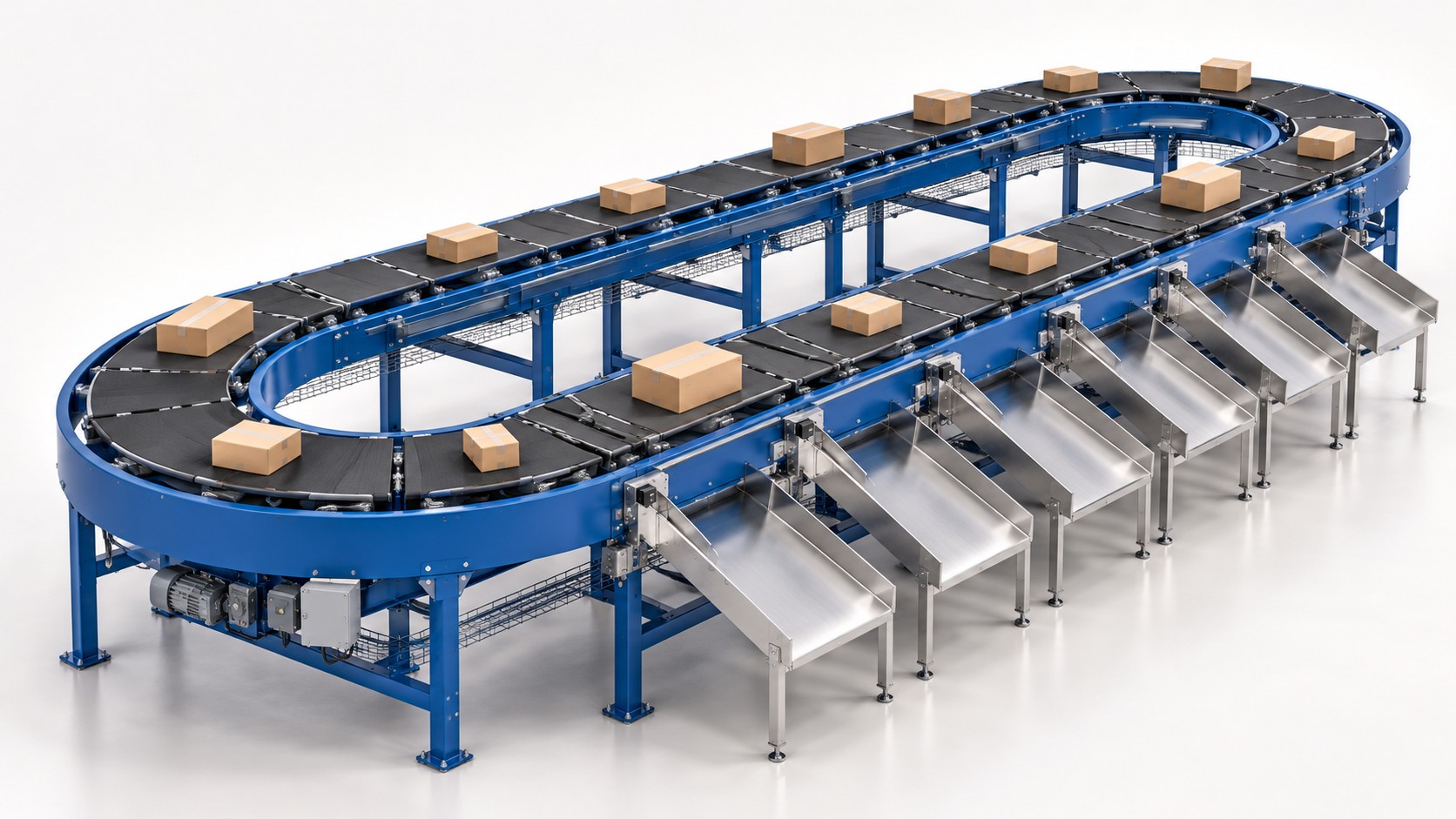
A STARTING POINT FOR SELECTION
Which sorter should you consider first?
The bands below are planning suggestions, not equipment limits or guaranteed outputs. Compare your required sustained peak rate with a supplier’s validated system capacity, including operational allowances.
Start with inline conveyor and diverts
A useful first option for a small number of routes and suitable cartons or totes. Consider a switch or swivel-wheel sorter where modular routing is useful. Many destinations or difficult-to-handle items may justify a cross-belt solution even at this rate.
Compare enhanced inline sorting with cross-belt
Assess high-performance diverts, multibelt switches and vertical cross-belt systems. Prioritise product trials and destination count: a few carrier lanes and dozens of order destinations are different design problems.
Shortlist by product and layout
Compare sliding-shoe or high-performance multibelt systems for linear flows, and vertical or horizontal cross-belt for carrier-based handling. A compact straight layout may favour vertical cross-belt; a loop may better suit multiple induction areas.
Assess high-capacity sorter architectures
Horizontal cross-belt, sliding-shoe and suitable tray systems merit investigation. Some vertical cross-belt configurations cover the lower part of this band. Induction, destination clearance and recirculation become decisive.
Engineer the whole system
Evaluate specialist high-rate loops, multiple sort zones or parallel sorters. Confirm whether a quoted rate counts unique items, carrier movements or repeated use of carriers around a circuit.
These recommendations are an engineering shortlist inferred from the published examples below. A sorter operating near its quoted maximum may not have enough allowance for your required sustained output.
TECHNOLOGY AT A GLANCE
Compare sorter types.
Published examples, not universal ranges. The figures describe specific products or manufacturer guidance. They are not Keymas performance guarantees, and do not imply that every model in a category offers the same capacity.
| Technology | Published reference | A strong candidate when… | Check before choosing |
|---|---|---|---|
| Inline conveyor with diverts | Dematic discusses simple divert options for applications below 5,000 cartons/hour with few destinations. [1] | You need a relatively simple straight-through route with branches. | The conveyor alone does not sort. Transfers, spacing and the required diversion pattern determine performance. |
| Switch / swivel-wheel sorter | GEBHARDT SwitchSorter®: up to 2,500 unit loads/hour, based on 600 × 400 mm goods. [2] | You handle suitable totes, cartons or trays and want modular left/right routing. | Base stability, wheel contact, transfer angle and item dimensions. Soft bags need specific validation. |
| High-performance multibelt switch | Interroll BM 1300: up to 10,000 items/hour. [3] | You need higher-rate inline diversion without a full carrier loop. | Do not apply this rating to all “switch sorters”. Check the exact module, item spacing and downstream layout. |
| Vertical cross-belt | Interroll MX-V technical data: 2,000–12,500 items/hour. Its headline also cites up to 14,000 carriers/hour; confirm the basis. [4] | You need controlled cross-belt discharge in a compact, predominantly straight installation. | Carrier size, multi-carrier items, feed rate and the treatment of missed or unavailable destinations. |
| Horizontal cross-belt | Interroll MX-H: 4,000–20,000 items/hour. [5] | You need a loop layout, mixed-item handling and flexible destination placement. | Loop footprint, induction balance and capacity consumed by recirculating items. |
| Sliding-shoe sorter | Dematic describes configurations achieving up to 18,000 cartons/hour. [1] | You have a substantial linear carton flow and multiple outbound lanes. | Product suitability, divert angle, gaps and takeaway speed. Validate small, soft or irregular items separately. |
| Tilt-tray / split-tray | Interroll MT-S split-tray: up to 21,600 items/hour, maximum item weight 8 kg. This is not a general tilt-tray rating. [6] | Your items suit a tray and its discharge action; small-item order sorting may favour split-tray designs. | Tilt-tray tips its load; split-tray opens beneath it. Validate drop, fragility, chute design and tray occupancy. [7] |
UNDERSTAND THE DIFFERENCE
Similar names. Different layouts.
Convey, identify, divert.
“Inline conveyor” describes a layout rather than one sorting mechanism. A belt or roller line needs identification, tracking and a divert device to send items to different destinations.
“Switch sorter” is also used broadly. Ask whether the proposal uses swivel wheels, pop-up wheels, belts or another transfer mechanism.
A return path underneath.
Carriers circulate in an over-and-under arrangement. The sorting run is generally straight, with the return beneath it. “Vertical” does not mean a goods lift.
Plan an exception route: a vertical machine does not automatically provide the loaded-item recirculation of a horizontal loop. [8]
A loop around the floor plan.
Carriers travel around a horizontal circuit, with small transverse belts discharging items sideways. The loop can return undischarged items for another attempt. [8]
Recirculation helps manage exceptions, but it occupies capacity. It is not a substitute for keeping destination lanes clear.
SIZE THE COMPLETE PROCESS
Items per hour is only the beginning.
Start with your operating window.
Illustrative example: 24,000 items over a four-hour dispatch window require 6,000 successful sorts/hour on average. If the busiest hour reaches 8,000, that peak must inform the design.
If your agreed planning assumption is 80% effective utilisation, 8,000 ÷ 0.80 = 10,000 items/hour of nominal capacity. The 80% is an example, not an industry default; validate it against your operation and avoid counting the same allowance twice.
Check pitch, not just belt speed.
For a simple single-file flow:
Theoretical items/hour =
3,600 × speed (m/s) ÷ item pitch (m)
At 1 m/s with a 0.5 m item plus a 0.25 m gap, the ideal flow is 4,800 items/hour. This assumes uniform, continuously available items. It is not a guaranteed sorting rate.
For carrier sorters, carrier pitch and occupancy matter too. An item spanning two carriers can reduce the number of unique items processed, even when the carrier rate is unchanged.
Specify successful first-pass sorts separately from total presentations. The sustainable result is constrained by the weakest stage: feed, identification, induction, sorting or destination clearance.
BRING THE RIGHT INFORMATION
What we need to recommend a sorter.
01 / Product profile
Minimum and maximum dimensions, weight distribution, cartons versus bags, base condition, fragility and a sample of difficult items.
02 / Demand profile
Daily volume, busiest hour and short bursts, operating windows, seasonal peaks and expected growth.
03 / Destinations
Number of routes, volume per route, busiest destination, container changes and how quickly sorted items are removed.
04 / Building and integration
Available footprint and height, access routes, existing conveyors, scanning requirements, controls and WMS interfaces.
The best sorter is the one that handles your real workload.
Ask for a capacity assessment against your product mix and destination pattern, with agreed availability, exception handling and acceptance criteria.
Discuss your throughput requirements ↗Manufacturer references
Reviewed 12 November 2026. Figures can differ between generations, configurations and rating methods. Confirm the current specification for the proposed equipment.
- Dematic — Sorting Out Sortation: linear diversion and sliding-shoe examples, pages 6–7.
- GEBHARDT — SwitchSorter®: unit-load dimensions and throughput.
- Interroll — BM 1300 Multibelt Switch: model-specific maximum.
- Interroll — MX-V Vertical Crossbelt Sorter: technical item-rate range and headline carrier rate.
- Interroll — MX-H Horizontal Crossbelt Sorter: item-rate range.
- Interroll — Sorter Solution Portfolio: MT-S split-tray maximum.
- BEUMER — BG Sorter ET: tilt-tray architecture and application.
- Interroll — Crossbelt Sorters catalogue: vertical/horizontal layout and recirculation principles; older catalogue used for architecture, not current capacity ratings.